
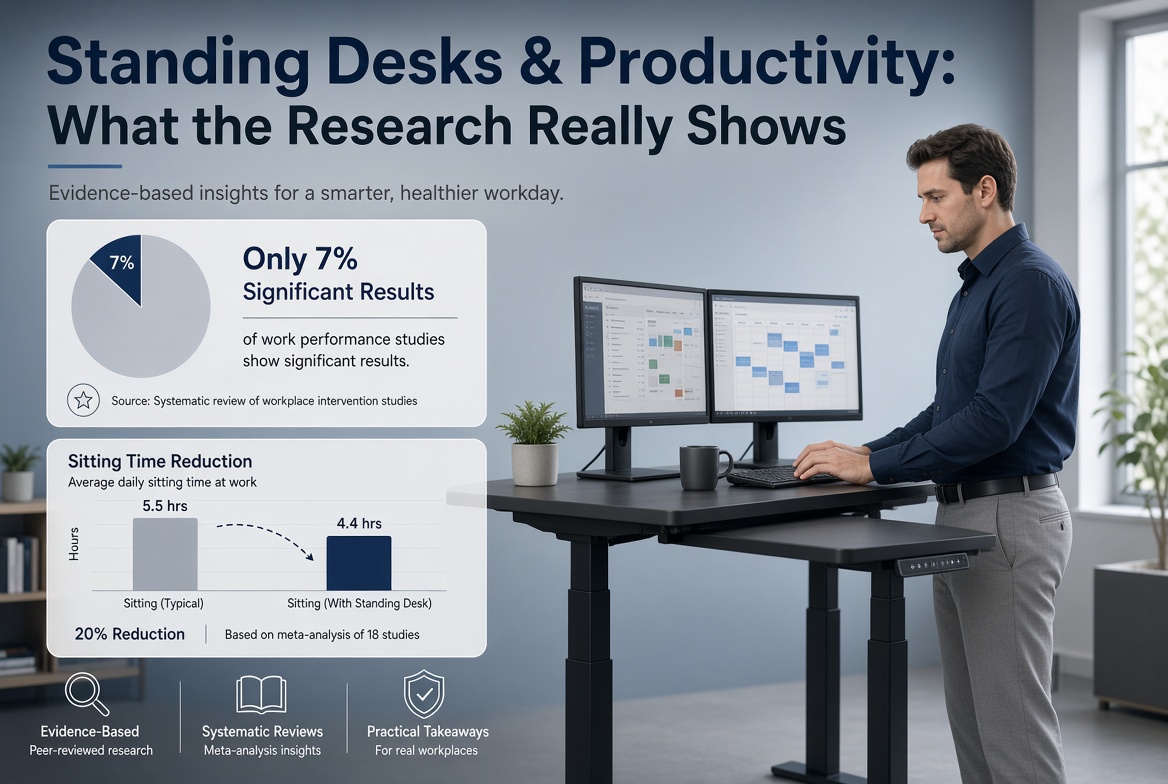
Can I double my concentration and productivity at once by switching to a standing desk? The standing desk allows you to work in alternating sitting and standing positions without leaving the workspace. But through my own trial and error and in-depth research, I’ve found that marketing phrases often confuse between simply reducing sitting time and actually doing more. Reducing the amount of time spent in a chair can greatly help with physical comfort, but actual daily performance depends largely on the nature of the work you are performing, personal comfort, and the state of the work space.
What Research Says About Standing Desk and Work Performance
The 53-Study Review: What Did Researchers Discover?
To distinguish between actual performance and marketing hype, I looked at a comprehensive scoping review for 2019 on PubMed. The researchers analyzed 53 papers that evaluated behavioral, physiological, and psychological aspects, discomfort, posture, and work performance results.
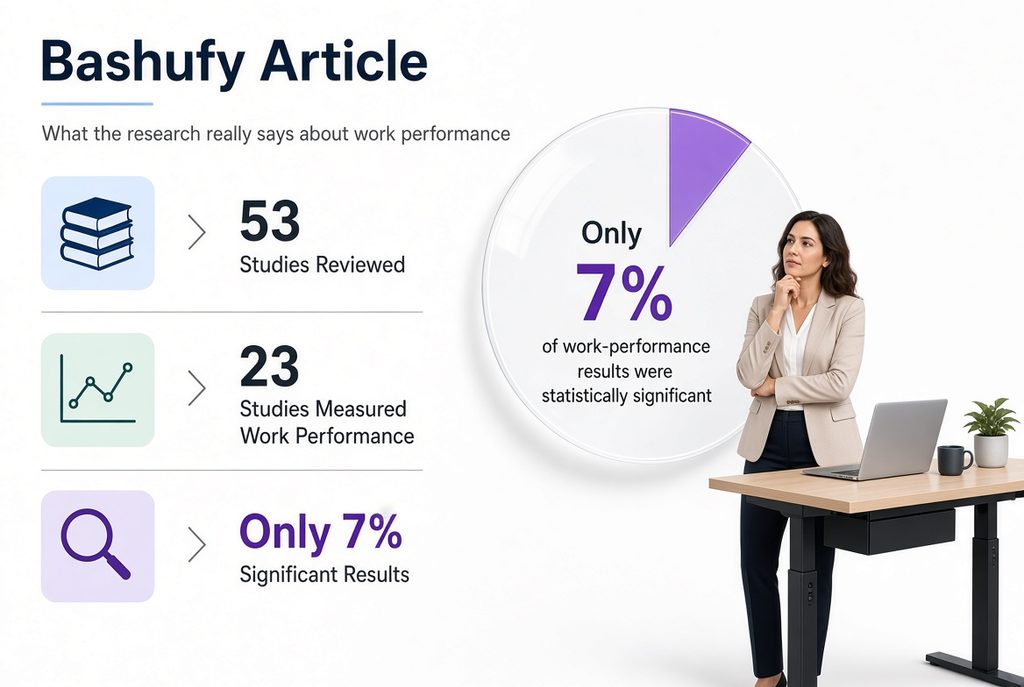
Of the 23 studies that specifically measured work performance, only 7% showed statistically significant improvements. And what I want to make clear here is that this 7% figure represents an improved percentage of the measured performance indicators, not the percentage of people who have suddenly become productivity adherents. From what I’ve read in this literature review, there is much more evidence of the ability to change the physical habits of sitting or standing than evidence that a standing desk dramatically improves work productivity.
Does Standing Help or Hurt Performance?
The positive thing I found in this study is that standing desks do not normally interfere with general office work. The argument that standing up improves typing speed, deep concentration, or total workload on its own is not supported by extensive data, but standing up does not impair normal performance.
A Four-Week Study: Productivity and Sitting Time in Numbers
What Happened During the 2025 Study?
I also reviewed a 2025 study published in the Journal of Occupational and Environmental Medicine, which followed 18 white-collar workers and 15 students for four weeks to observe changes in real life.
Reduced Sitting Time: White-collar workers reduced sitting time during daily work from 5.5 hours to 4.4 hours, a significant reduction of about 1.1 hours on average per day.
Productivity Self Report: White-collar workers reported a statistically significant improvement in their subjective productivity (P=0.01).
Differences in Student Groups: Interestingly, student groups did not show similar changes in terms of sitting time or productivity improvement.
While these findings are encouraging, I will not conclude that all standing desk users will see a dramatic increase in productivity due to limitations such as a small number of participants, a short study period, and differences between the target groups.
Four Ways a Standing Desk May Influence Your Workday
1. Comfort and the Ability to Stay on Task
In my experience, changing positions helps relieve the physical fatigue and clumps of sitting for hours. But balance is important. If you stand for too long without a break, your legs and feet can quickly build up. When I first switched to standing up, enduring muscle pain was a big challenge. If you have the same problem, you learn how to manage the fatigue of standing up in half an hour, and you can focus on your work instead of your sore feet.
2. Concentration While Working on Computers
I always distinguish between “feeling awake” and “actually immersed in complex tasks.” While standing may make you feel clearer, there is still limited consistent and measurable evidence that standing increases cognitive concentration, according to the results of systematic studies compiled in “Human Factors.”
3. Energy and Afternoon Work Performance
Like many people, I often experience a lack of energy in the middle of the afternoon. Switching to a standing position while sitting for a long time can significantly improve the energy and blood flow felt. However, I found that simply standing up cannot be a panacea for everyone.
4. Efficiency of Work & Completion of Tasks
When I evaluate my productivity, I look at specific results: completed tasks, error rates, and quality of work. Standing in front of a desk and feeling active is good for your body, but I can assure you from my experience that being active doesn’t automatically produce more results.
Sitting, Standing, and Walking: Which Is Better for Different Tasks?
Over time, I realized that the level of physical stability required varies depending on the type of work.
Standing Up: If your desk height is properly adjusted, I think this posture is ideal for email replies, phone calls, reading documents, and doing daily computer work.
Walking (Treadmill Desk): While increasing the number of steps is good, studies in Occupational and Environmental Medicine show that walking while typing or mouse manipulation reduces the ability to control fine movements, which can interfere with typing accuracy and mouse manipulation accuracy.
Sitting Down: In my workflow, sitting down is still the best option for in-depth intensive tasks that require continuous precision and absolute physical stability.
Rather than being forced to stand all day, I follow a flexible routine, alternating between sitting and standing.Figuring out how long to stand at a standing desk has made a world of difference in balancing my daily comfort with steady output.
How to Use a Standing Desk Without Disrupting Productivity
Adjust the Workstation Before Changing Your Routine
Before changing my daily work habits, I always check my work environment carefully again.According to the my research, configure my workspace as follows:
- Adjust the desk height so that the elbow is about 90 degrees angled without straining your shoulders.
- Place one-third of the top of the monitor exactly at eye level to keep your head and neck neutral.
- Keep your keyboard and mouse close enough not to reach out. Take the time to create the right standing desk workspace to keep you comfortable with each change of posture.
Build Position Changes Into Your Work Schedule
- It is recommended to start with a short standing time of 15 to 20 minutes and gradually increase as the body adapts.
- Use your posture naturally alternately. Stand when you have a video conference or organize your inbox, and sit down when you need writing or precise computer work.
- When sitting in front of your desk for a long time, move your body briefly and relax for blood circulation.
Measure Your Own Results Daily
I recommend you record your work, error rate, concentration level, and comfort you’ve completed in a week or two. Do not rely solely on a single day of experience, especially busy or idle, compare and evaluate similar work schedules.
When a Standing Desk Might Not Improve Productivity
I think the standing desk is not an all-around solution that solves all work problems at once. Discomfort caused by standing too long, incorrectly adjusting desk height, shoes that do not support the feet properly, or being held in one position can easily reduce concentration on work. When I first used an unfamiliar desk environment, the adaptation process itself felt a bit distracting until I fitted everything perfectly.
If you already have joint or back pain, we strongly recommend seeking personalized ergonomic advice. Standing desks should never replace actual physical activity, adequate rest, or properly placed work space.
Conclusion: What the Evidence Actually Means
When I put together the scientific evidence and my personal experience, the conclusion is clear. While standing desks are great for reducing sitting time every day, there is limited evidence that they continue to increase productivity. The way it works for me may feel a little different depending on your daily work or comfort level. Focus on organizing your desk so that you can change your posture smoothly and easily, and judge its value based on your comfort and concentration rather than relying on conventional wisdom about productivity.

Aamir Riaz is the founder and owner of Bashufy. After years of working with uncomfortable desks and learning the importance of better posture, he shares honest standing desk reviews, buying guides, and ergonomic tips based on research and real user experiences to help readers make better choices for their home office setup.